Case Study VIII: We Choose the Moon, We Choose Earth#
This case study now documents the working Abjad score for We Choose the Moon, We Choose Earth. The piece began as a Logic Pro production plan for a space-themed activist art song, but the current version has moved into a notated lead-score format for the available class ensemble: voice, violin, viola, trumpet, and piano. The result is not only a lead sheet and not only a fully fixed concert score. It is a hybrid artifact: the score gives the players written material, chord changes, dynamics, vocal text, and formal cues, while still leaving room for piano interpretation and eventual production work.
Note#
Unlike other works I have been doing recently, this work is not algorithmic in nature. It is a demonstration of how to use Abjad and Python for writing conventional notated music via code, which is surprisingly accessible if you have clear musical ideas/fragments in mind from the get-go. As this is a song, I had ideas for chord changes and melodic lines and worked one section at a time. Most folks will probably prefer to write using WYSIWYG using Dorico but with the help of coding agents, it is possible to translate your musical ideas into Abjad+Python!
Download#
Format |
Link |
Duration |
|---|---|---|
Full Score PDF |
n/a |
|
WAV |
4:13 |
|
MIDI |
4:13 |
Part Downloads#
Part |
Link |
|---|---|
Voice |
|
Violin |
|
Viola |
|
Trumpet in C |
|
Trumpet in B-flat |
|
Piano |
|
Chord Voicing Guide |
Listen#
Duration: 4:13
Score Preview#

Personal Background#
My plan for the final composition in COMP 246 begins from a much older personal background. Starting when I was ten years old, before there was an internet, I used to send letters to NASA. I was especially excited by interplanetary missions, above all Viking I and Viking II to Mars. NASA sent me large packets of articles and photographs, and those materials stayed with me. When I think about what makes America great, NASA is the first thing that comes to mind. The Artemis II mission left me, and much of the world, speechless while we found ourselves living through yet another war.
Project Inspiration#
The piece places John F. Kennedy’s 1962 Rice University moon speech in conversation with the Artemis II mission. It does not treat the moonshot only as a historical event. It presents it as an idea that still matters: people working together, doing difficult work, and serving a public purpose, even in hard times.
Kennedy’s words provide the public voice of the song.
His repeated ideas of choice, challenge, and resolve shape the spoken vocal line and the refrain.
The emotional turn comes from Artemis II, especially Christina Koch’s line, We choose Earth.
That response changes the meaning of the moon mission.
It is not about escaping the world.
It is about choosing Earth and choosing one another.
The title, We Choose the Moon, We Choose Earth, states the main idea. The first half comes from Kennedy’s call to take on difficult work together. The second half comes from the modern mission’s reminder that exploration brings us back to Earth and to each other.
Source Texts#
The Artemis II crew was Reid Wiseman, Victor Glover, Christina Koch, and Jeremy Hansen. The modern response in this project is drawn especially from Christina Koch’s words:
With this burn to the Moon, we do not leave Earth. We choose it.
We will always choose Earth.
We will always choose each other.
The main Kennedy lines shaping the song are:
We choose to go to the moon.
We choose to go to the moon in this decade and do the other things
not because they are easy, but because they are hard.
Because that goal will serve to organize and measure the best of our energies and skills
that challenge is one that we are willing to accept,
one we are unwilling to postpone,
and one we intend to win.
Current Musical Form#
The current Abjad draft is seventy-nine measures long in 4/4 at quarter note = 76. It now expands the classroom lead score beyond the first verse/refrain/bridge outline by adding a second verse, a short refrain return, a brief loss-of-signal passage, and an outro.
Section |
Measures |
Dramatic Function |
Musical Treatment |
|---|---|---|---|
Intro |
1-8 |
Establishes liftoff atmosphere before the text enters. |
Quiet open fifths, high string shimmer, viola pedal, and distant trumpet signal. |
Verse |
9-18 |
Presents Kennedy’s opening declaration as public speech. |
Mostly spoken vocal rhythm with sparse instrumental responses and piano roots/voicings. |
Refrain |
19-37 |
Opens the piece into the |
More melodic vocal contour, stronger trumpet answers, and richer jazz-influenced harmony. |
Verse 2 |
38-47 |
Extends Kennedy’s image of setting sail on a new sea. |
Reuses the Verse 1 harmonic and instrumental frame with new vocal text. |
Short Refrain |
48-55 |
Returns the refrain in compressed form before the Artemis turn. |
Uses the opening refrain material as a shorter formal signal. |
Bridge |
56-67 |
Turns toward Artemis II and |
Suspended harmony and colder string color, with the vocal line moving toward the modern response. |
Loss of Signal |
68-71 |
Creates a short blackout after the bridge. |
Mostly rests, held tones, and sparse open sonorities. |
Outro |
72-79 |
Closes with the shared |
Quiet communal ending built from the bridge/coda material. |
This version intentionally omits guitar from the notated score. The original plan included guitar, but the class instrumentation is uncertain and a guitarist could improvise from the chord lead sheet if one is available. Removing the guitar staff keeps the score readable and focuses the written ensemble on the musicians known to be available.
Instrumentation and Roles#
The score uses voice, violin, viola, trumpet, and piano. The piano part is written on two staves, but it is not meant to be a completely fixed accompaniment. The left hand shows the root or bass path, while the right hand gives practical voicings that explain the chord symbols. This makes the jazz color easier to read for classically trained players and gives the pianist a usable voicing cheat sheet.
The violin and viola are treated as color and gravity rather than as generic padding. The violin often supplies high shimmer, sustained chord tones, and star-field gestures. The viola grounds the harmony with slow inner motion and pedal tones. The trumpet is written for a solid jazz player: it begins as a distant mission signal, then grows into more lyrical answers during the refrain and bridge. The score includes a concert-pitch trumpet part and a B-flat trumpet part with transposed pitches and chord symbols.
Harmony#
The harmonic language moved away from simple major-fifth sonorities toward readable jazz color. The goal is a space sound without making the chord chart too complex for the ensemble. Representative sonorities include:
D5andDadd9for open launch and public declaration.Dmaj9/F#for a bright but grounded expansion.Gmaj7(#11)for the Lydian star-field color.A13sus4andA7for suspended propulsion and release.Bm11andEm9for a wider, more suspended refrain and bridge.
The chord labels in the score are written as standard rehearsal symbols.
The piano staff shows practical left-hand and right-hand voicings, and the command-line build also writes a generated Markdown reference at build/art-song-chord-voicings.md.
Lead-Score Design#
The notation is designed to read as a lead sheet/score hybrid. The full score includes:
chord labels above the ensemble;
a mostly spoken vocal line with lyric underlay;
rehearsal boxes for each formal region;
written violin, viola, trumpet, and piano material;
dynamics and hairpins that create a gradual buildup and a quieter ending;
layout control so systems are limited to about four measures per line;
ragged last-system spacing, so the final line is not stretched unnaturally across the page.
The individual part PDFs include chord labels and a vocal cue line. This is important because the piece depends on text pacing and formal awareness, not only on each player’s notes. The B-flat trumpet part receives both transposed notation and transposed chord labels.
Current Outputs#
The art-song command now generates the full score, part scores, MIDI, LilyPond files, and the chord voicing cheat sheet.
python -m art_song -o build --pdf --midi --wav
The expected generated files are:
Artifact |
Status |
Notes |
|---|---|---|
|
Generated |
Full lead-score for voice, strings, trumpet, and piano. |
|
Generated |
MIDI rendering of the current notated score. |
|
Generated |
Layered SoundFont render of the current notated score. |
|
Generated |
LilyPond emitted from the Abjad score model. |
|
Generated |
Voice part with chord labels. |
|
Generated |
Violin part with chord labels and vocal cue. |
|
Generated |
Viola part with chord labels and vocal cue. |
|
Generated |
Concert-pitch trumpet part with chord labels and vocal cue. |
|
Generated |
B-flat trumpet part with transposed pitches and chord symbols. |
|
Generated |
Piano part with chord labels and vocal cue. |
|
Generated |
Measure-by-measure chord and piano voicing reference. |
Implementation Notes#
The current score is generated in art_song.score.
The implementation moved from a placeholder score toward structured Abjad data:
each part is stored as measure-level Python data;
validation checks that every part has the expected number of measures;
validation checks that each measure totals 4/4;
chord labels are generated from the same measure structure as the score;
lyrics are derived from vocal annotations and attached as lyric underlay;
dynamic maps and hairpin ranges are attached by measure number;
part builders share the same source material as the full score;
the command-line tool writes the full score, all parts, and the voicing reference.
Some low-level LilyPond literals remain where Abjad does not provide a higher-level convenience for the exact output needed, such as lyrics, page layout, and explicit system breaks. The main musical structure, however, now lives in Python data and Abjad objects rather than in a large handwritten LilyPond string.
Original Production Plan#
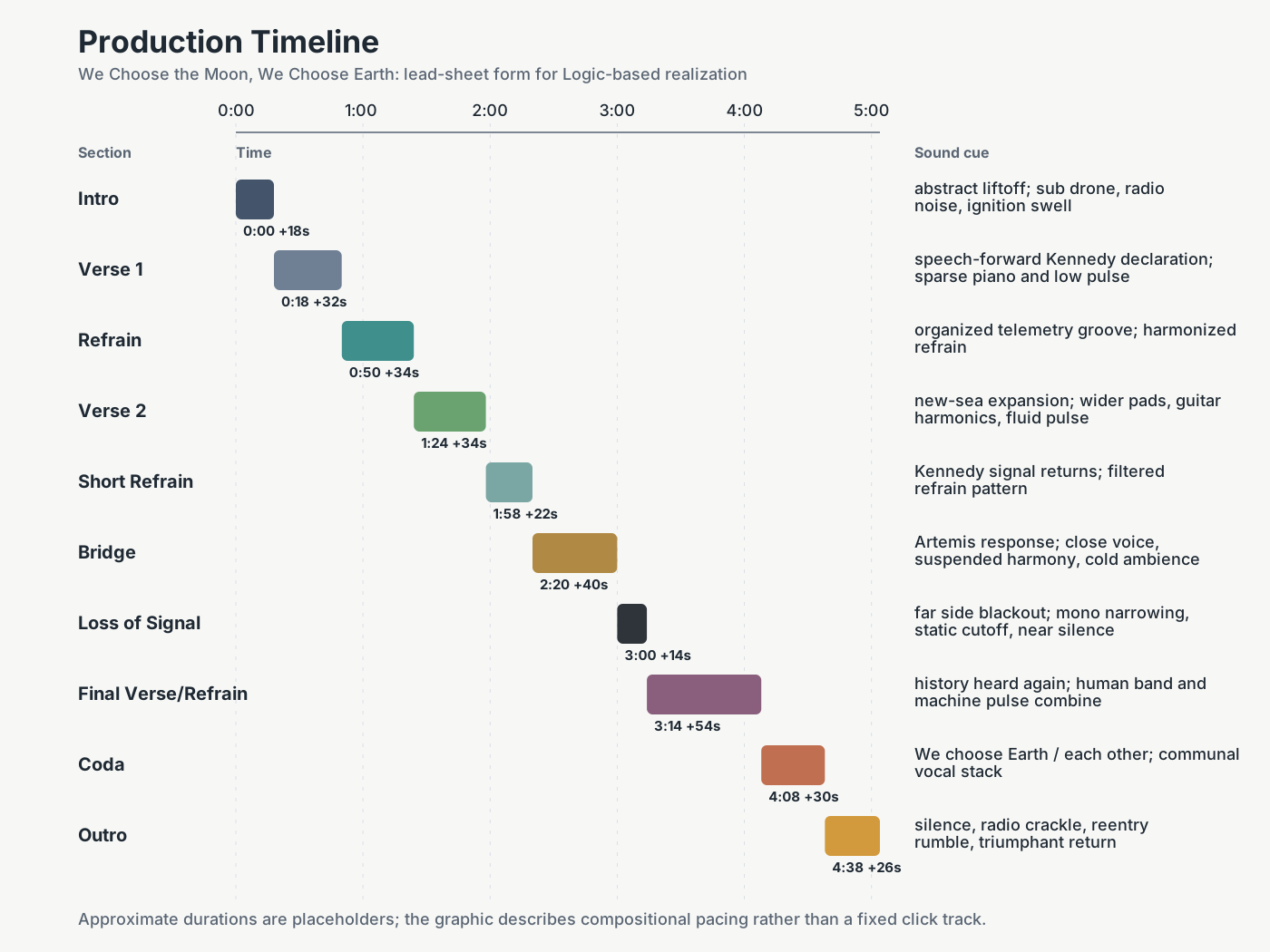
The earlier plan imagined the piece as a Logic Pro production with sampled rocket, radio, telemetry, reentry, and splashdown sounds. That production plan is still useful, but it is now secondary to the notated classroom score. The sound-design ideas can return later as a produced version or as performance notes.
Section |
Start / Duration |
Vocal Function |
Sound World |
Rhythm / Gesture |
Logic Realization |
|---|---|---|---|---|---|
Intro: abstract liftoff |
0:00 / 0:18 |
No lyric yet; the piece begins as mission atmosphere. |
Sub drone, filtered rocket rumble, radio static, countdown fragments, metallic ticks, and a slow rising synth pressure. |
Free or semi-free time; irregular machine pulses gather toward the first verse. |
Alchemy drone, Quick Sampler rocket layers, Step FX gating, automated filter opening into the first downbeat. |
Verse 1: Kennedy’s opening declaration |
0:18 / 0:32 |
Speech-forward recitation with only slight melodic shaping at line endings. |
Sparse piano or electric piano, low synth pedal, muted kick or tom pulse, occasional radio artifacts between phrases. |
Slow and grounded; the accompaniment should leave space for the public-address quality of the text. |
Dry-to-medium vocal room, restrained bass entrance, subtle tape or console saturation. |
Refrain: |
0:50 / 0:34 |
The voice becomes more melodic; key words may be doubled or harmonized. |
Telemetry beeps, sequenced synth pulse, switch-click percussion, sidechained pad. |
A measured groove appears, suggesting systems coming online and collective effort becoming organized. |
Retro Synth or Alchemy arpeggiator, Step Sequencer click pattern, Logic Compressor sidechain movement. |
Bridge: Artemis II response |
1:24 / 0:40 |
Close, intimate vocal delivery centered on |
Drums drop out; cold lunar-orbit ambience, suspended pad, isolated piano tones, faint spacecraft interior sounds. |
Time can loosen here; the bridge should feel like a change of perspective rather than a bigger chorus. |
Automation removes groove elements, brings the vocal closer, and shifts the harmony to a more suspended place. |
Coda / reentry image |
2:04 / 0:30+ |
The final vocal can return quietly rather than ending as a full anthem. |
Silence, radio crackle, sub reentry rumble, white-noise heat, then a softened final chord. |
Dramatic interruption followed by return; the ending should feel like reentry rather than a simple fade. |
Automated silence, Quick Sampler radio click, filtered noise rise, final full chord. |
Timeline Graphic#
The generated timeline below preserves the earlier production roadmap visually. It should now be read as a future production layer, not as the exact form of the notated classroom score.
Lyric Draft#
We Choose the Moon, We Choose Earth

Verse 1
We choose to go to the moon.
We choose to go to the moon in this decade
and do the other things,
not because they are easy,
but because they are hard.

Refrain
Because that goal will serve
to organize and measure
the best of our energies and skills,
because that challenge is one
that we are willing to accept,
one we are unwilling to postpone,
and one we intend to win.

Verse 2
We set sail on this new sea
because there is new knowledge to be gained,
and new rights to be won,
and they must be won
and used for the progress of all people.

Short Refrain
Because that goal will serve
to organize and measure
the best of our energies and skills,
one we are willing to accept,
one we are unwilling to postpone,
and one we intend to win.

Bridge
With this burn to the moon,
we do not leave Earth.
We choose it.
We choose Earth.
We will always choose Earth.
We will always choose each other.

Loss of Signal
[instrumental blackout]

Outro
We choose Earth.
We choose each other.
We choose Earth.
Revision Plan#
The immediate next phase is not to add more instruments. It is to make the current lead-score clearer for rehearsal.
Decide whether above-staff spoken annotations should remain, or whether the lyric underlay is now enough.
Review the trumpet part with the jazz player and adjust register, articulation, and space for improvisatory response.
Check whether the piano voicings are idiomatic enough to read while still leaving room for improvisation.
Refine dynamics after hearing the ensemble balance, especially the buildup into the refrain and the quieter ending.
Decide whether the original Logic Pro sound-design plan should become a later produced version or a separate companion recording.